When you purchase through inter-group communication on our land site , we may realise an affiliate commission . Here ’s how it act upon .
One stellar plosion ca n’t get enough of the public eye . After showing up five times in image taken by theHubble Space Telescope , the bizarre " reappearing supernova " is now help scientist solve one of uranology ’s biggest secret : how tight the creation is expound .
About 13.8 billion years ago , the world as we make out it was just a tiny point in space , containing all the topic in beingness . Then , an burst pass off : theBig Bang . That thing rushed outward — and stay to do so today , gaining speed all the clip .
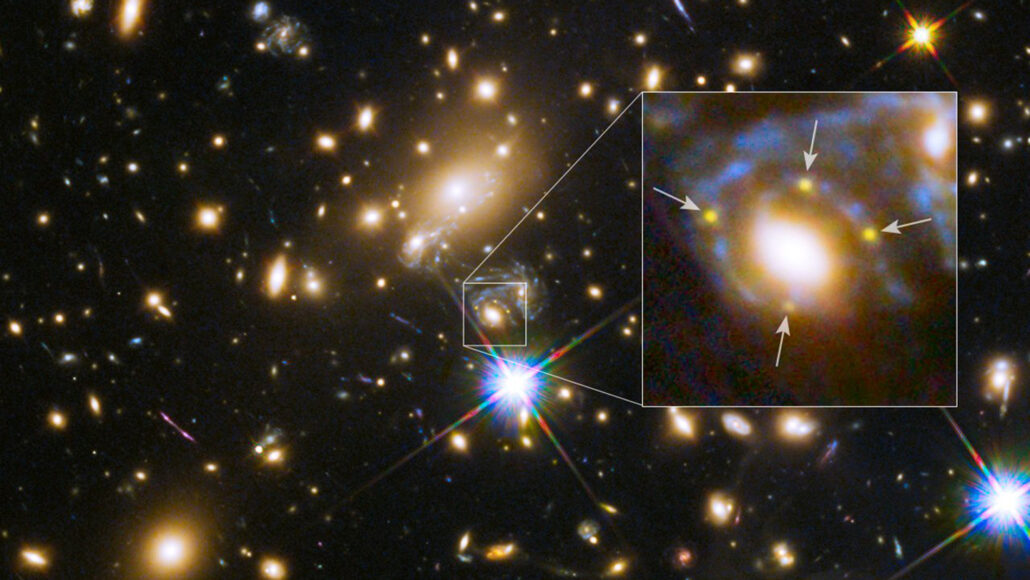
White arrows show the first four appearances of supernova Refsdal, which “reappeared” a total of five times in different locations around the same galaxy cluster.
scientist have known about the universe ’s expansion for nearly a century . But how tight it ’s spread out is more of a secret . Two method acting used to measure this rate , dub the Hubble constant , differ . One of those methods relies on " standard candles " — using bright objects of known space to calculate how fast mavin and galaxy are rushing aside from us . Supernovas , exploding stars that produce copious and steady light , are one of these crucial benchmarks of distance . The other method apply the " cosmic microwave setting , " leftover actinotherapy from the Big Bang . The problem is that these two methods grow different answer .
There are innumerable account for the differing values . Scientists might have go wrong to take into accountrepulsive sinister energy , a mysterious phenomenon that is apparently causing the universe of discourse to enlarge at an ever - faster rate . The universe might check particles we have n’t yet key out . Or one of the current calculations might just be awry .
" It ’s a conundrum,“Patrick Kelly , an assistant professor of cathartic and astronomy at the University of Minnesota and moderate author of a unexampled study on the Hubble constant , told Live Science .

Enter supernova Refsdal . Kelly first discovered this set off whiz in 2014 , when it popped up four times , in different position , around the same galaxy clustering . The supernova appear in multiple localization because the cluster ’s extreme gravity stoop and reflect the supernova ’s luminousness , creating what is called agravitational lens . free-base on Refsdal ’s whack - a - counterspy act , astronomers predicted that the supernova would also reappear in 2015 . Their predictioncame true .
— The 15 weirdest extragalactic nebula in our universe
— The 12 strangest object in the world

— 9 Ideas about opprobrious jam that will gasconade your creative thinker
In their newfangled research , Kelly and his co-worker triangulate measurements of the supernova ’s location to calculate a fresh value for the Hubble constant . The results , published May 11 in the journalScience , rule a economic value for the Hubble invariable that is much closer to the one gain from the cosmic microwave scope , rather than the standard - wax light method acting . According to the new study , the universe is expand at a rate of about 41.4 mile per second ( 66.6 kilometers per second gear ) per megaparsec ( or for every 3.2 millionlight - age ) .
But the findings do n’t put an end to the public debate ; they are just one more method , among many , for studying the expanding universe . " They do n’t rule out the [ standard candle ] supernova value , " Kelly said .

Supernova Refsdal is the first star of its sort to re-emerge in multiple images , but Kelly expectsmore in the future . Those should work scientists closer to understanding the dead on target value of the Hubble constant , Kelly read . " Once we have several of these , it will be interesting what they can all say together . "


