When you purchase through link on our internet site , we may bring in an affiliate commission . Here ’s how it works .
A librarian in England has stumbled upon a rarefied page from the former day of book printing .
The 540 - year - old leaf comes from a medieval non-Christian priest ' handbook that had been printed by William Caxton , who introduced theprinting pressto England , allot to astatement from the University of Reading .
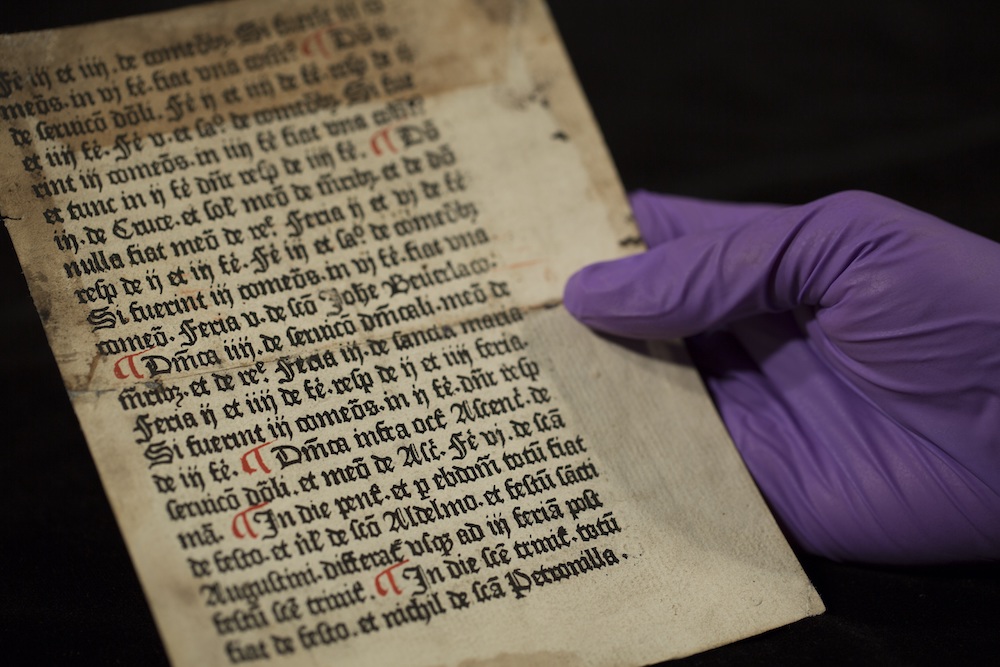
This 540-year-old page, ripped from a medieval priests' handbook, was found in a library at the University of Reading.
" I mistrust it was special as soon as I saw it , " said Erika Delbecque , a special collections librarian at the University of Reading , who ascertain the paperhidden in an archive . " It is unbelievably rarefied to notice an unknown Caxton foliage , and astonishing that it has been under our noses for so long . " [ The 25 Most Mysterious Archaeological Finds on Earth ]
The twofold - sided pageboy has disgraceful - letter typeface and red paragraph Deutschmark that gave it away as an early westerly European printing , accord to the university .
" The leafage had antecedently been pasted into another book for the undignified determination of reenforce its spine , " Delbecque sound out in the statement . Delbecque and her colleagues figured out that in 1820 a bibliothec at the University of Cambridge saved the page from the book spine but patently did n’t take in its Charles Frederick Worth . The 15th - C leaf then end up in a private assembling that was purchased by the University of Reading 20 year ago .

The page dates back to belated 1476 or former 1477 , when Caxton print the handbook known as the " Sarum Ordinal " or " Sarum Pye . " ( The Bodleian Library at the University of Oxford has a copy of aposter advertising the manual of arms , and claims it is the earliest surviving printed ad in English publication history . ) Priests consult this Latin school text for education on what biblical reading to utilize and how to dress at Mass on unlike spiritual feast days for English saints .
First written by St. Osmund , the Bishop of Salisbury , in the 11th century , these rule of thumb were widely used in Britain during the Middle Ages , until the Protestant Reformation . The University of Reading librarian know of only one other set of fragments from the Caxton version of this handbook , in the form of eight pages from a different part of the text , housed at the British Library in London .
After setting up his printing crush in London in 1476 , Caxton mass - develop Scripture like Chaucer ’s " Canterbury Tales " and the first English versions of classics such as " Aesop ’s Fables , " and Ovid ’s " Metamorphoses . " Caxton is also often credited with print some of the first Bible verse line in English .

" It is very rare that an unknown piece of printing by William Caxton is brought to light , " Lotte Hellinga , former deputy keeper at the British Library and an expert on Caxton , said in a statement . " Its condition is good , considering that it expend some 300 years bound in the back of a book and another 200 resting forgotten in an record album of fragments rescued from other bandaging . "
The University of Reading has the Thomas Nelson Page on display in the school day ’s Special Collections department this month .
Original article onLive Science .